
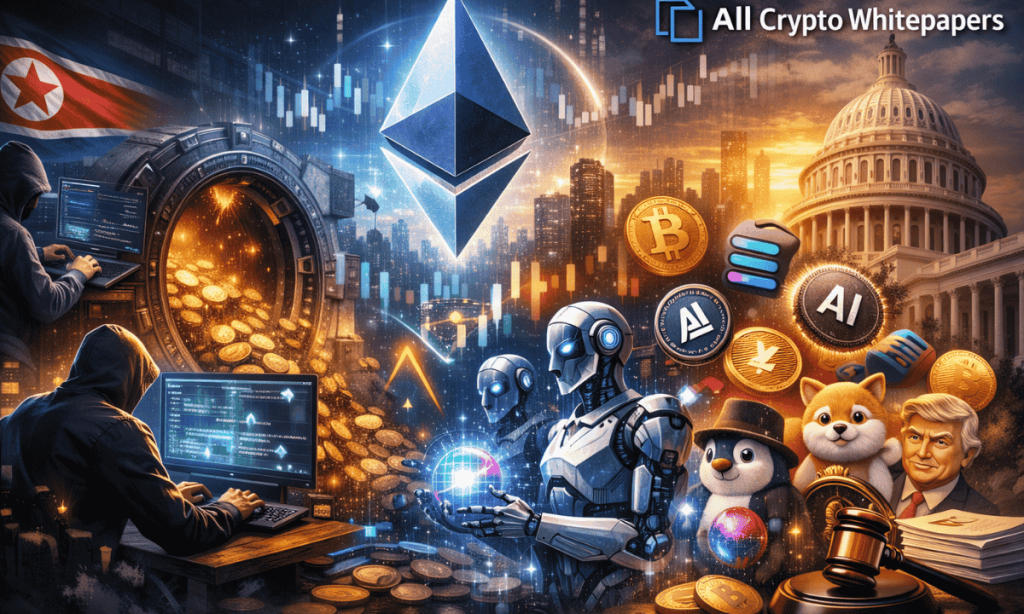
The first week of April 2026 has delivered everything crypto markets are known for: a massive security breach, regulatory anticipation, and wild sector rotations that left most traders scratching their heads. While Bitcoin continues its seemingly endless drift between $63,000 and $75,000, the real action happened elsewhere. From North Korean hackers pulling off one of the year’s biggest heists to AI tokens defying gravity in an otherwise brutal market, this week proved that crypto never sleeps, even when it looks comatose.
The Drift Protocol Disaster: When $285 Million Vanishes in 12 Minutes
Let’s start with the elephant in the room. On April 1st, Drift Protocol got absolutely wrecked. Not April Fools; actually wrecked. The Solana-based decentralized perpetual futures exchange, which had been quietly chugging along as one of DeFi’s more reliable platforms, saw roughly $285 million drain from its vaults in what can only be described as a masterclass in patience and precision.
This wasn’t some kid stumbling onto a smart contract bug. According to blockchain intelligence firm TRM Labs, the attack bore all the hallmarks of North Korean state-sponsored hackers, the same crews behind the 2022 Wormhole bridge hack that cost $326 million. What made this particularly nasty was the timeline. The preparation started weeks earlier, on March 11th, when attackers pulled 10 ETH from Tornado Cash and began setting the stage.
Here’s where it gets technical but important: they manufactured an entirely fake token called CarbonVote (CVT), seeded minimal liquidity, ran some wash trading to create price history, and somehow convinced Drift’s oracles that this worthless token was legitimate collateral worth hundreds of millions. Then, through what appears to be social engineering, they got protocol signers to pre-authorize transactions that looked routine but were actually loaded weapons.
The kill shot came on March 27th when Drift’s governance removed time locks from administrative actions. That elimination of the detection window was the final piece. On April 1st, those pre-signed transactions executed. CVT got listed as valid collateral. Withdrawal limits got cranked to absurd levels. And then, 31 withdrawal transactions over 12 minutes pulled real assets like USDC and JLP straight out of the protocol.
Most of the stolen funds bridged to Ethereum within hours. The DRIFT token tanked 40%. Deposits and withdrawals got suspended. And the contagion spread fast. Over 20 protocols that had exposure to Drift felt the pain. Prime Numbers Fi reported millions in losses. Carrot Protocol paused functions after losing half its total value locked. Pyra Protocol disabled withdrawals entirely, trapping user funds.
The lesson here isn’t particularly new, but it’s worth repeating until DeFi learns it: timelocks aren’t optional decoration. They’re the difference between catching an attack during staging and watching it execute perfectly. Drift’s governance removed that safeguard five days before the exploit. That decision alone turned a preventable incident into 2026’s largest DeFi hack.
Market Conditions: The Great Apathy
While Drift burned, the broader crypto market continued its zombie walk through what’s shaping up to be one of the strangest periods in recent memory. Bitcoin’s been stuck in its $63K to $75K range for over two months now. Trading volume collapsed more than 35% week over week. The Fear and Greed Index hit 9 out of 100, “Extreme Fear” territory, and has camped there for 46 consecutive days.
You know what’s wild? Gold and the S&P 500 bottomed and rebounded over the past few weeks. Traditional risk assets found their footing. Crypto just didn’t follow. That decoupling tells you something important about capital flows. Or rather, the lack of them. Retail’s tuned out. They’re not buying dips anymore. They’re not panic-selling either. They’ve just left the building.
The on-chain data paints an even grimmer picture. Small retail wallets spent the last two months buying every dip, expecting Bitcoin to rocket back to six figures. Meanwhile, smart money, the wallets that historically get it right, have been quietly distributing. That divergence rarely ends well for the optimists.
But here’s the thing about low-volatility, low-volume grinds: they don’t last forever. Historically, when crypto markets go this quiet, they’re building pressure for a move. The question isn’t if something breaks; it’s when and in which direction. Many analysts are closely watching Bitcoin price prediction trends to gauge the next major movement.
Ethereum’s Glamsterdam: The Upgrade Everyone’s Watching
If there’s a legitimate catalyst on the horizon, it’s Ethereum’s Glamsterdam upgrade slated for June. This isn’t some minor optimization. We’re talking about increasing the gas limit from 60 million to 200 million per block and scaling throughput to 10,000 transactions per second. That’s the biggest technical overhaul since the Merge back in 2022.
History suggests this matters for price action. The Merge triggered a 35% rally in the two months before launch. Shanghai’s staking withdrawal upgrade drew nearly 40%. Dencun pushed ETH up about 20%. The pattern’s consistent: markets front-run major Ethereum upgrades by four to six weeks.
Right now, ETH trades around $2,000 to $2,100, down roughly 60% from its cycle high. If the historical playbook holds and Glamsterdam launches on schedule in June, we should start seeing positioning in April. Some analysts are eyeing the $2,700 to $2,900 zone as a realistic target if upgrade momentum builds and nothing goes catastrophically wrong with testnet deployments.
But, and this is a meaningful but, if Glamsterdam gets delayed to Q3, all bets are off. Ethereum’s been in consolidation hell for months. Institutional ETF flows have been brutal, with $207 million in net outflows during a single week in late March while Bitcoin ETFs kept stacking inflows. The divergence between institutional appetite for BTC versus ETH has never been wider. Investors tracking Ethereum network upgrades should pay close attention to the development timeline.
AI Tokens: The Only Thing Working
Here’s the plot twist nobody saw coming: while everything else bleeds or flatlines, AI crypto tokens are absolutely ripping. Over the last four weeks, the AI sector is the only category posting positive returns. And we’re not talking modest gains.
Bittensor (TAO) surged 67.5%. Render (RENDER) climbed 21%. SIREN, whatever the hell that is, exploded 540% in a month. FET gained 44%. When the rest of crypto looks like a morgue, AI tokens are throwing a party.
The narrative makes sense on paper. AI and crypto are the two dominant tech stories of our time. Combine them, and you get decentralized machine learning networks, AI-powered DeFi strategies, and infrastructure plays that sound futuristic enough to pull capital even in a risk-off environment.
But let’s be real: this looks like classic sector rotation. In crypto, these things move in cycles. First, a sector rips (we’re here). Then it consolidates for three to four weeks while early winners correct. Then, if the thesis holds, it rips again even harder. We’ve seen this movie with meme coins. We’ve seen it with real-world asset tokenization. The question is whether AI tokens are building legitimate value or just the current hot narrative before capital rotates somewhere else.
One trader on X put it bluntly: “I’m DCAing into TAO every single day until we hit $500. ” I honestly believe this will be one of the best-performing assets of 2026. “That kind of conviction either ages like fine wine or curdled milk. No middle ground. For those interested in this sector, understanding how AI and blockchain technology converge is crucial.
Solana’s Memecoin Mania Returns
Speaking of narratives, Solana memecoins are showing signs of life after months in the wilderness. Weekly DEX volume on Solana surged from a low of $40.5 billion back in August 2025 to $87.8 billion in the last week of March. That’s not a typo. Nearly doubled in seven months.
Tokens like BONK, PENGU, TRUMP, PIPPIN, and POPCAT are seeing renewed trading activity. Whether this is sustainable or just another pump-and-dump cycle remains to be seen, but the volume doesn’t lie. People are trading Solana memecoins again, and that tends to drive ecosystem activity even when the broader market looks dead.
Regulatory Tea Leaves: The CLARITY Act
On the regulatory front, all eyes are on the CLARITY Act, which should see its draft released sometime in early April. This would be the first major U.S. crypto regulatory framework to reach the full Senate, and institutional allocators are watching closely.
The bill’s been in limbo for months, facing pushback and revisions, but the fact that it’s advancing at all signals something important: Washington is trying to build actual rules instead of regulation by enforcement. Whether those rules end up being workable or a disaster for innovation remains an open question, but clarity beats ambiguity. Usually.
Globally, we’re seeing a coordinated push toward bringing crypto into existing regulatory perimeters. The UK is incorporating digital assets into its Financial Services and Markets Act framework. The EU’s MiCA regulations are shaping how stablecoins and exchanges operate across member states. Even jurisdictions that were hostile, Kenya and Hong Kong, are warming up.
The common thread: governments want oversight, licensing requirements, and consumer protections without necessarily killing the industry. That’s a dramatic shift from the “ban first, ask questions later” approach we saw in places like Bolivia and Bangladesh a few years back. Those following cryptocurrency regulation developments should monitor these legislative changes closely.
What’s Next?
If this week taught us anything, it’s that crypto remains wildly unpredictable even when it looks calm. A $285 million hack executed with military precision. AI tokens defying a bear market. Ethereum is gearing up for its biggest upgrade in years. Regulatory frameworks advancing. Memecoins are making a comeback on Solana.
And through it all, Bitcoin just keeps grinding sideways, accumulating frustration and potential energy. Something’s going to give. The funding rates show aggressive shorting on both BTC and ETH, which creates potential for a violent squeeze higher if sentiment shifts. But macroeconomic headwinds, geopolitical tensions, inflation concerns, and rate uncertainty continue weighing on risk assets broadly.
For traders and investors, the playbook seems straightforward even if execution isn’t: watch for the Glamsterdam upgrade timeline, keep an eye on AI token consolidation for potential re-entry points, and don’t ignore the regulatory developments that could reshape market structure overnight.
One thing’s certain: crypto isn’t boring. Even when it tries to be.
FAQs
Q: What happened with the Drift Protocol hack?
Drift Protocol, a Solana-based decentralized exchange, lost $285 million on April 1, 2026, in a sophisticated attack likely carried out by North Korean hackers. They used fake collateral tokens and social engineering to drain the protocol in just 12 minutes.
Q: When is Ethereum’s Glamsterdam upgrade launching?
The Glamsterdam upgrade is scheduled for June 2026. It aims to increase Ethereum’s gas limit from 60 million to 200 million and scale throughput to 10,000 transactions per second, making it the biggest technical upgrade since the 2022 Merge.
Q: Why are AI crypto tokens performing well?
AI tokens like Bittensor (TAO), Render (RENDER), and others have gained 20% to 67% recently because they combine two dominant tech narratives, artificial intelligence and blockchain, attracting capital even during broader market weakness.
Q: What is the CLARITY Act?
The CLARITY Act is proposed U.S. legislation expected to provide the first comprehensive regulatory framework for digital assets. Its draft release in early April 2026 could signal clearer rules for crypto companies and institutional investors.
Q: Is the crypto market in a bear market?
The market is in a consolidation phase rather than an outright bear market. Bitcoin has traded between $63,000 and $75,000 for over two months with extremely low volatility, while the Fear and Greed Index shows “Extreme Fear.” However, specific sectors like AI tokens are showing strong performance.