
Walleteum Whitepaper
Category: Recently Added Whitepapers
Wallabee Whitepaper
Wallabee Whitepaper
Aaron Platform Whitepaper
Aaron Platform Whitepaper
Acash Corporation Whitepaper
Acash Corporation Whitepaper
8×8 Whitepaper
8×8 Whitepaper
Antimatter Kingdom Whitepaper
Antimatter Kingdom Whitepaper
The Antimatter Kingdom whitepaper describes a cryptocurrency project that claims to introduce a new blockchain ecosystem built around a concept called the Capital Cell Fission Blockchain (CXC). According to the project narrative, the system is designed to create a decentralized digital economy supported by mining mechanisms, token distribution, and a broader ecosystem intended to grow over time. The whitepaper presents the project as a large-scale technological initiative aiming to develop a long-lasting commercial network driven by blockchain infrastructure and token incentives. (Decrypt)
Within the proposed system, participants are encouraged to contribute capital or digital assets to the ecosystem through specialized mining or investment programs. The project claims that these mechanisms would generate returns and support the growth of the underlying token economy. The whitepaper frames this model as part of a broader vision of building a large-scale decentralized financial ecosystem centered on the Antimatter Kingdom token and its associated blockchain technology.
However, outside analysis has raised concerns about the project’s structure and claims. Security researchers and industry observers have linked Antimatter Kingdom to schemes that promised unusually high or “exponential” returns to participants, which is a common warning sign in cryptocurrency investment programs. (Decrypt)
Overall, the whitepaper presents Antimatter Kingdom as an ambitious blockchain ecosystem built around mining programs, token incentives, and a proprietary blockchain architecture, though the project’s claims and economic model have attracted significant skepticism from observers in the crypto industry. (https://www.allcryptowhitepapers.com/antimatter-kingdom-whitepaper/)
This summary is provided for informational purposes and was generated from the referenced whitepaper; readers should consult the original document for full technical details.
1Million Token Whitepaper
1Million Token Whitepaper
The 1Million Token whitepaper presents a cryptocurrency project designed around a fixed token supply and a community-driven ecosystem. The token operates as an ERC-20 asset on the Ethereum blockchain and is intended to function as a utility token that can be traded on cryptocurrency exchanges and used within related online services. The project emphasizes simplicity in its token structure, with a total supply capped at one million tokens, a model intended to create scarcity and predictable issuance within the ecosystem.
Aptos Whitepaper
Aptos Whitepaper
In the web2 version of the Internet, services such as messaging, social media, finance, gaming, shopping, and audio/video streaming, are provided by centralized companies that control direct access to user data (e.g., Google, Amazon, Apple, and Meta). These companies develop infrastructure using application-specific software optimized for targeted use cases and leverage cloud infrastructures to deploy these applications to users. Cloud infrastructure provides access to virtualized and/or physical infrastructure services, such as rented virtual machines (VMs) and bare metal hardware operating inside data centers worldwide (e.g., AWS, Azure, and Google Cloud). As a result, building web2 Internet services that can scale to billions of users has never been easier than it is today. However, web2 requires that users place explicit trust in centralized entities, a requirement that has become increasingly concerning to society.
To combat this concern, a new Internet age has begun: web3. In the web3 version of the Internet, blockchains have emerged to provide decentralized, immutable ledgers that enable users to interact with one another securely and reliably, all without requiring trust in controlling intermediaries or centralized entities. Similar to how web2 Internet services and applications rely on cloud infrastructure as building blocks, decentralized applications can use blockchains as a decentralized infrastructure layer to reach billions of users across the world.
However, despite the existence of many blockchains today, widespread adoption of web3 has not yet taken place [3]. While technology continues to advance the industry, existing blockchains are unreliable, impose high transaction fees for users, have low throughput limitations, suffer regular asset losses due to security issues, and cannot support real-time responsiveness. In comparison to how cloud infrastructure has enabled web2 services to reach billions, blockchains have not yet enabled web3 applications to do the same.
The rise of blockchains as a new Internet infrastructure has led to developers deploying tens of thousands of decentralized applications at rapidly growing rates. Unfortunately, blockchain usage is not yet ubiquitous due to frequent outages, high costs, low throughput limits, and numerous security concerns. To enable mass adoption in the web3 era, blockchain infrastructure needs to follow the path of cloud infrastructure as a trusted, scalable, cost-efficient, and continually improving platform for building widely-used applications.
We present the Aptos blockchain, designed with scalability, safety, reliability, and upgradeability as key principles, to address these challenges. The Aptos blockchain has been developed over the past three years by over 350+ developers across the globe. It offers new and novel innovations in consensus, smart contract design, system security, performance, and decentralization. The combination of these technologies will provide a fundamental building block to bring web3 to the masses:
• First, the Aptos blockchain natively integrates and internally uses the Move language for fast and secure transaction execution. The Move prover, a formal verifier for smart contracts written in the Move language, provides additional safeguards for contract invariants and behavior. This focus on security allows developers to better protect their software from malicious entities.
• Second, the Aptos data model enables flexible key management and hybrid custodial options. This, alongside transaction transparency prior to signing and practical light client protocols, provides a safer and more trustworthy user experience.
• Third, to achieve high throughput and low latency, the Aptos blockchain leverages a pipelined and modular approach for the key stages of transaction processing. Specifically, transaction dissemination, block metadata ordering, parallel transaction execution, batch storage, and ledger certification all operate concurrently. This approach fully leverages all available physical resources, improves hardware efficiency, and enables highly parallel execution.
• Fourth, unlike other parallel execution engines that break transaction atomicity by requiring upfront knowledge of the data to be read and written, the Aptos blockchain does not put such limitations on developers. It can efficiently support atomicity with arbitrarily complex transactions, enabling higher throughput and lower latency for real-world applications and simplifying development.
• Fifth, the Aptos modular architecture design supports client flexibility and optimizes for frequent and instant upgrades. Moreover, to rapidly deploy new technology innovations and support new web3 use cases, the Aptos blockchain provides embedded on-chain change management protocols.
• Finally, the Aptos blockchain is experimenting with future initiatives to scale beyond individual validator performance: its modular design and parallel execution engine support internal sharding of a validator and homogeneous state sharding provides the potential for horizontal throughput scalability without adding additional complexity for node operators.
NFT whitepapers
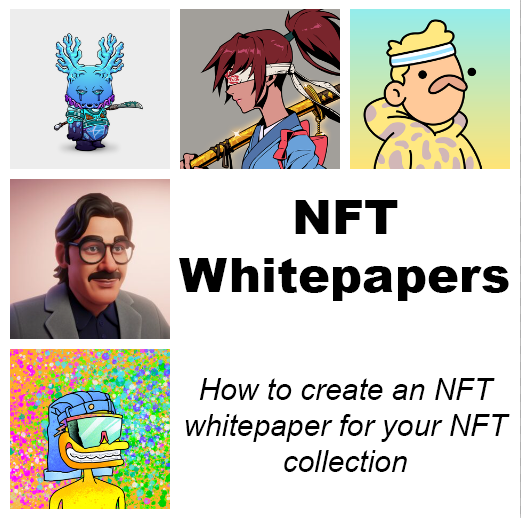
How to create an NFT whitepaper for your NFT collection
After the surge of cryptocurrencies, Defi, and now NFT’s, the market is saturated with many projects that have no or little merit. The best way to choose which NFT or crypto is best for your investment is to start with analyzing the website, team, communities, and especially the whitepaper. Do they even have a whitepaper? How much time and effort have they placed in creating their whitepaper? Are there any details that have caught your attention?
In this article we go over the questions if you even need a whitepaper to launch an NFT collection, and how to do the research and whitepaper design to create a solid base for your new project.
Do you need a whitepaper for your NFT collection?
An NFT whitepaper is a digital document that provides an in-depth explanation of what NFTs are, how they work, and the applications of the particular NFT you intend to launch. But before we dive deeper into how to create a whitepaper for your NFT collection, let’s first ask ourselves, do you even need a whitepaper for your NFT collection?
The short answer; NO. The right answer; YES. Whitepapers, whether for NFT’s or cryptocurrency tokens, can be used to explain how a new NFT project works, the team behind it, the marketing strategy, and the timeline. See it as a business plan or investment pitch but then for your NFT collection. NFT’s are still very new and that’s why it’s super useful to new investors to learn about your project via your whitepaper.
What is the difference between a crypto whitepaper and NFT whitepaper?
Generally, whitepapers for a cryptocurrency project seem to be much more in-depth compared to NFT whitepapers because NFT projects do not have to explain tokenomics, mathematical models or the economic model behind the token.
NFT whitepapers can be more focused on the design aspects, how the community will interact and how it’ll be marketed. NFT whitepapers are mostly designed to be relatively simple to understand, using informative graphics, infographics and clear diagrams and designs.
How to create an NFT whitepaper for your NFT collection

Although the content of your NFT whitepaper is very important, it is not the only factor in a white paper’s success. You also need to consider you really the design of your pages, adding elements that grab people’s attention and reflect your brand in the way that you want present it to potential contributors. Here are the 3 areas to focus on when writing your NFT whitepaper:
Research
The first starting point of writing a good NFT whitepaper is doing your research. From analyzing the competition, the communities around those projects, and other NFT’s marketing strategies to identifying your ideal customer, audiences, and the industry. Once you have laid the groundwork for creating your ideal customers, then start creating your game plan for communicating to them.
Design
A well-designed and informative NFT whitepaper is the foundation for a successful NFT launch. An easy-to-read whitepaper should be easy on the eyes. A good cover initiates that trust factor from potential contributors and showcases the look and feel of the project. Keep the photo quality high and maintain a consistent style throughout the document. Especially because NFT’s are so design-focused, it’s highly recommended to spend more time on the design than you normally would.
Marketing
After the creation of your whitepaper, business plan, and obviously, the NFT collection itself, only half of the work is done. Now it’s time to launch in the market and create your community around the project. This is why it is extremely important to already start with communication and thinking about your marketing plan. Where are you going to invest your time and energy? How will you communicate your message properly and which platforms will you be using?
Overall, make sure to properly format your NFT whitepaper so that the reader can easily navigate through your paper and understand any of the (technical) details. Make sure visuals, infographics and designs are on point and consistent and easy to share and promote.
NFT whitepaper example
One of the best examples of a properly done NFT whitepaper is the one of VISA on Engaging Today’s Fans in Crypto and Commerce with NFT’s. You can find the whitepaper here, and take inspiration for your own NFT whitepaper.
Overall, it is definitely recommended to create a whitepaper for your NFT collection. Wether you use it or not, it is always good to take the time to create a solid researched game-plan before you go out and put a lot of effort in your NFT project while maybe realizing it might have no merit in the current NFT market. Another good starting point is to start with reading some of the valuable NFT books on the market, to have better starting point for creating your own NFT whitepaper. We’d love to learn more about your project and if you’re NFT whitepaper is finished, feel free to submit it to our database here!
Follow me on Twitter for more information about NFT whitepapers and NFT investing !
Bored Ape NFT Price
On this page you can track BAYC NFT prices across multiple platforms. We have analytics on traits, last sales and floor prices of BAYC.
What is BAYC?
BAYC stands for Bored Ape Yacht Club, a project created by Yuga Labs. BAYC is an NFT collection (non fungible tokens) created in March 2021. Bored apes consists of 10.000 images of Apes that look bored. All the bored apes have different types of traits, which are design elements that make up the character. From a King’s crown to a spacesuit to gold skins, the apes are all different but have one thing in common: they are bored. Apart from the Bored Apes, Yuga labs launched multiple collections within the BAYC Ecosystem: Mutant Apes (MAYC), Bored Dogs (BKYC) and recently the Otherdeed land sale. The Otherside is a game where people can walk around with their Bored Ape and go on all kinds of missions. Each piece of land is unique and has their own resources. Some lands also have Kodas and artifacts. There are just 10.000 Kodas and they are expected to be a key element to play the Otherside Game. Yuga Labs also acquired CryptoPunks, which was one of the first PFP (Profile Picture) NFT projects. Punk are considered the real OG project and holy grail for NFTs, as many Punk holders are big in the NFT and Ethereum Space. The biggest Bored Ape holder is Dingaling, who is an anonymous NFT investor that has invested a lot in the space. His holdings are enormous and with the Apecoin Airdrop alone he made millions of dollars.
Bored Ape Yacht Club is one of the most popular NFTs at the moment. With over 6000 different holders that always get rewarded by getting new airdrops, tokens or party invites, they are considered one of the best collections in NFTs. Multiple big brands have purchased or licensed a Bored Ape for their marketing efforts. Yuga labs grew out to a billion dollar company in just a few months and is expected to become a serious media company in the upcoming years. They have recently hired a new CEO with a lot of experience in the media sector and have built a professional organization.
Fun fact about BAYC: it did not sell out immediately. It took them 5 days before they sold out and the reason for that was a big whale (Pranksy) minting 1000 Bored Apes. When everyone saw that he was minting, they started to mint quickly and it sold out in an instant. People at first were scared that the big whale Pranksy would dump all the apes and tank the collection’s floor price, but he held onto them for quite a while and sold off really slowly. He is part of the succes of BAYC by helping them sell out and helping the project forward in the first weeks.
Bored Ape NFT Prices.
Below you will find all kinds of statistics and charts related to the BAYC NFT prices:
These are the latest BAYC sales across all platforms:
This graph show you the entire number of BAYC sales and trading volume over time:
Here you can see an overview of the Bored Ape Yacht Club all time sales:
Conclusion
There are many ways to track BAYC pricing, but the best thing is always to check the BAYC contract on etherscan and verify the transactions. Some prices may look low, but it could very well be that the seller made a trade with the new owner, e.g. in NFTS or NFTs + Ethereum. Most platforms used are Opensea, Looksrare and X2Y2. If you want to learn more about NFTs or BAYC in general, feel free to reach out!